
Parsec Weekly #142
The Execution Layer Behind LayerZero

The Execution Layer Behind LayerZero
This week I want to dig into something that’s been nagging at me since reading @Evan_ss6‘s excellent piece on ZRO and the “Boomerification” thesis.

Evan makes the case that interoperability is one of four verticals worth focusing on as crypto integrates with TradFi. These comprise of picks and shovels that can earn fees regardless of whether the assets being traded are memecoins or tokenised equities.
LayerZero’s market share dominance (82% of cross-chain dollar volume per this BidCast interview), clean tokenomics (buybacks, positive insider flows) and the mysterious February 10th announcement all make for a compelling case.
But something’s missing from the conversation. Why the product is good enough to earn its market share?
The answer, in part, is an execution layer most users have never heard of: Aori.
The Cross-Chain Execution Problem
To understand why Aori matters, you need to understand how cross-chain intents actually work and why most of them kind of suck.
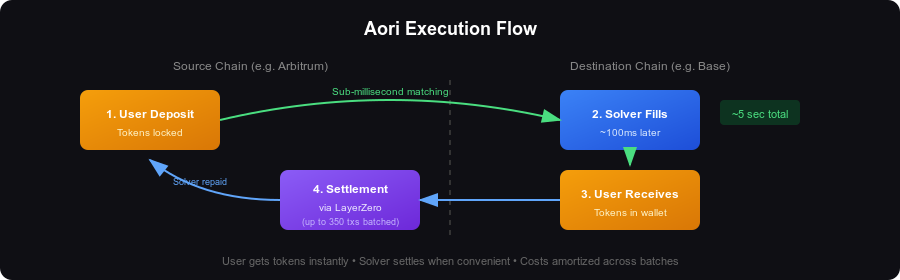
The basic flow: you want to move ETH from Arbitrum to Base. Instead of waiting for a bridge to verify and settle (slow), a “solver” fronts you the liquidity instantly on Base. You get your tokens immediately and the solver gets repaid later after the transaction is confirmed.
The difficulty here arises in that “later.”
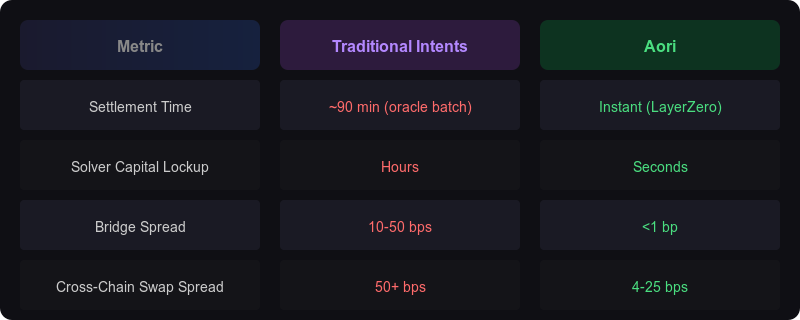
Most intent protocols batch-settle through oracles. Across, for example, uses UMA’s optimistic oracle which settles roughly every 90 minutes. That means when a solver fills your order, their capital is locked for up to 90 minutes before they get repaid.
Solvers price this lockup into their spreads to compensate for:
Time value of locked capital (can’t use it for other trades)
Volatility risk (price can move against them during settlement)
Rebalancing costs (getting inventory back to where they need it)
For cross-chain swaps (not just bridges), it’s even worse. If you’re swapping ETH for some long-tail token on another chain and the solver is exposed to volatility for a meaningful period, they’ll charge you a large spread to compensate.
As Aori’s founder Josh put it in a recent interview: “For a solver, effectively a market maker, everything about their pricing is about how fast they can hedge and how fast they can get their inventory back to where they want it to be.”
The longer a solver’s capital is locked, the wider they quote!
How Aori Solved It
Aori takes an entirely different approach by using LayerZero for settlement instead of batched oracles.
Here’s how it works:
Off-chain matching: Orders are matched in sub-millisecond latency (not waiting for block confirmations)
Instant fills: User deposits on source chain → solver fills on destination chain in the same block (~100ms after source block finalises)
LayerZero settlement: Instead of waiting for an oracle to batch-verify, solvers settle via LayerZero messaging whenever they want
Batching efficiency: Solvers can pack up to 350 transactions into a single settle call, amortising the cost to almost nothing per trade
The result: sub-basis point pricing on bridges (vs 10-50 bps elsewhere) and 4-25 bps on cross-chain swaps (vs 50+ bps for long-tail pairs elsewhere).
From their testing, the full end-to-end flow via LayerZero; deposit, fill, settle takes about 5 seconds. For context, the “optimistic” case for traditional intents is 3 minutes.
The key insight here is that speed isn’t just a UX feature but rather an economics feature. The reason your cross-chain swap “feels instant” is actually a byproduct of making the economics work for solvers. Faster settlement → lower capital lockup → tighter quotes → better prices for users.
Where You’ve Already Used It
If you’ve used Stargate infrastructure recently, you’ve probably touched Aori without knowing it...
Stargate Fast Swaps: Every cross-chain swap on Stargate’s frontend is powered by Aori. This is LayerZero’s flagship consumer product—the thing Brian (LayerZero CEO) is targeting $100M annualised revenue from within 12 months.
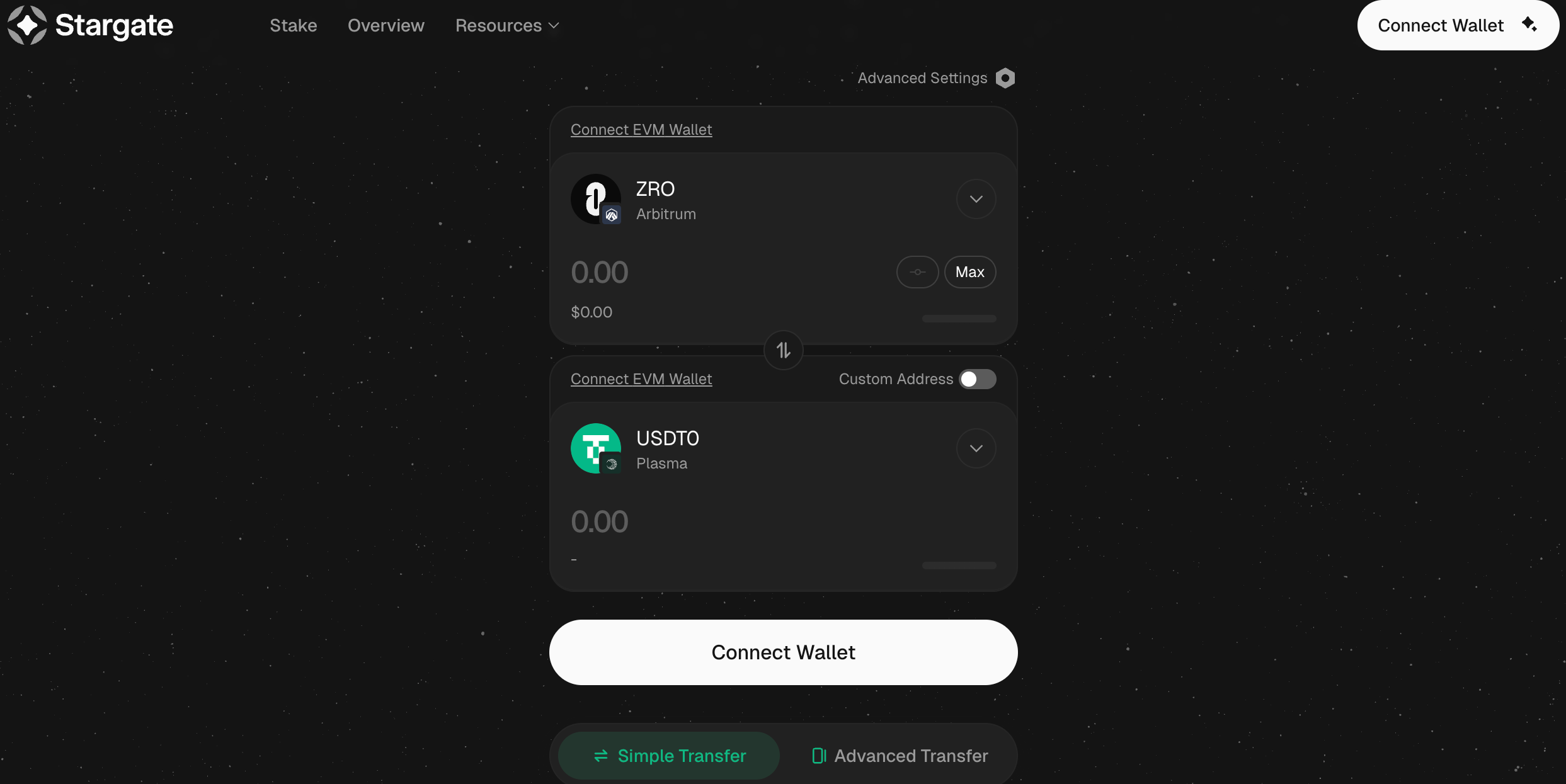
USDT0: Aori powers transfers on USDT0’s site, the cross chain extension of USDT that moved $63B in its first year.
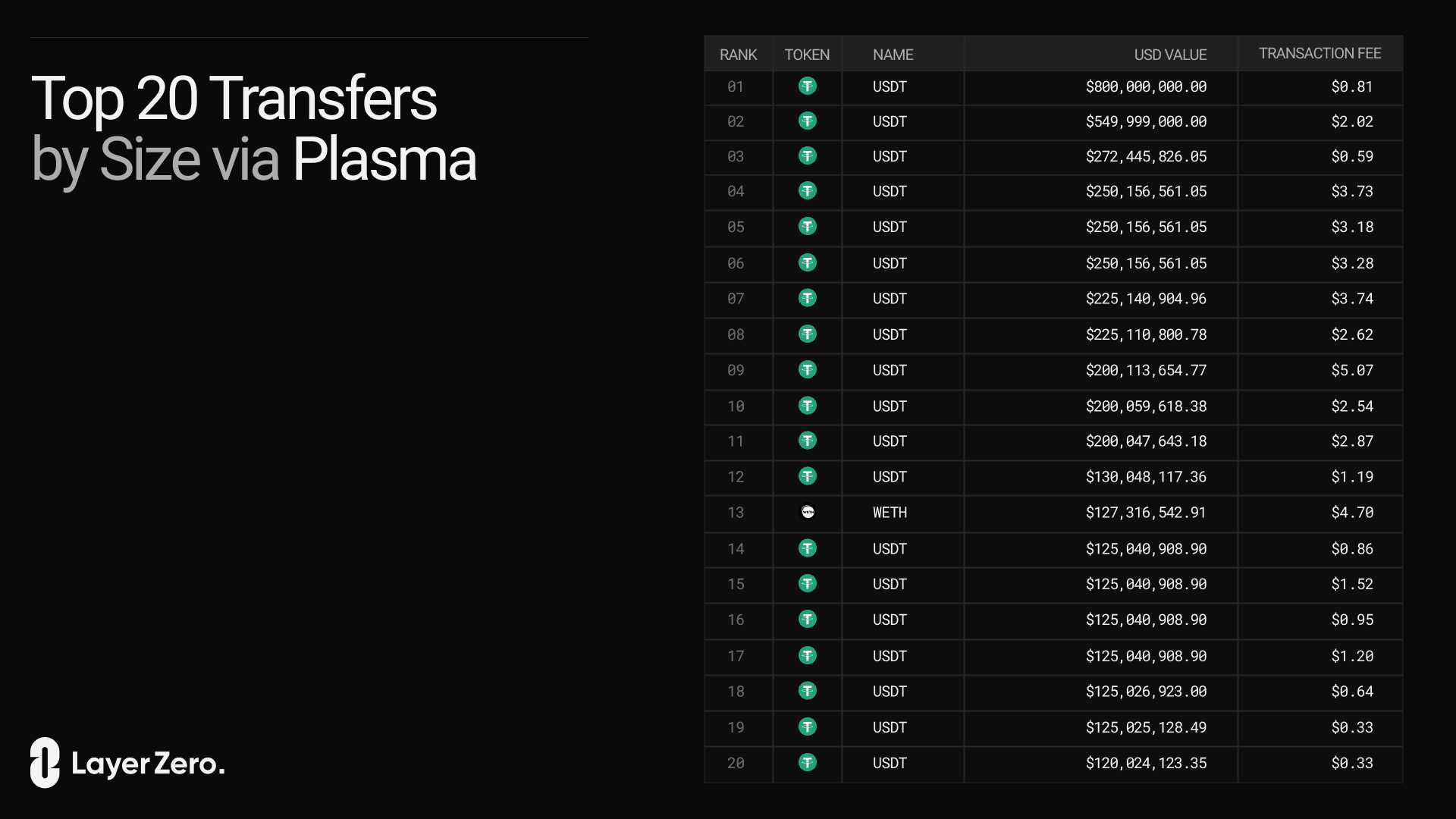
Plasma Launch: $8B+ deposits in a matter of days post-mainnet Launch with all Stargate→Plasma volume flowing through Aori. The largest transfer processed by LayerZero infrastructure was a whopping $800m transfer for merely $0.81 in cost with the largest Aori-facilitated transfer around $150m in value for equally negligible cost.
As day-one partners for the Monad and Stable launches, the pattern is clear: every major chain launch using LayerZero as canonical infrastructure inherits Aori as the execution layer.
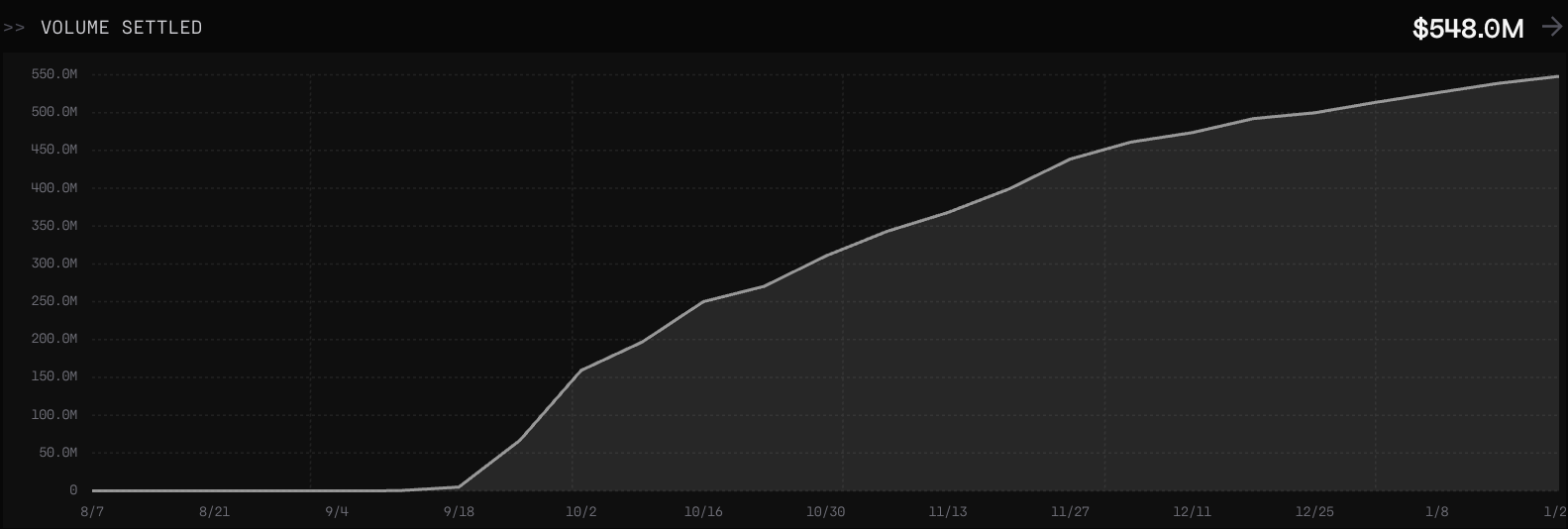
According to aoriscan, they’ve done ~$500m volume natively since going live in mid-September across 8 chains and 92 tokens:
The Investment Angle
So how does this connect to the ZRO thesis Evan laid out?
For ZRO holders/watchers:
Aori’s success flows directly to ZRO through Stargate. Brian has publicly stated a $100M annualised revenue target for Stargate within 12 months with 100% of excess revenue going to ZRO buybacks.
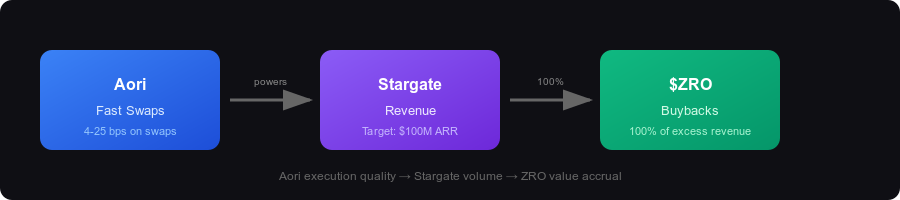
Stargate currently does ~$25M annualised. The path to $100M runs through three revenue streams:
Same-asset bridging (0.5-6 bps)
Cross-asset swaps via Aori (4-25 bps)
An undisclosed AUM-driven product line
The cross-asset swap business is the higher-margin play, and that’s Aori. The better Aori executes → the more volume Stargate captures → the more buyback pressure on ZRO.
For those wanting direct Aori exposure:
The team comes from market-making backgrounds (trading desks, MEV, options) and they’re building execution infrastructure. There is no talk of a token nor rush to TGE, this is either:
A future catalyst to watch
They stay as B2B infrastructure within LayerZero’s ecosystem indefinitely (and by extension are a likely acquisition target for LayerZero)
Either way, understanding execution under the hood helps you evaluate whether LayerZero’s dominance is defensible.
The broader thesis:
This connects to the “Boomerification” framework. LayerZero already has Dinari and Ondo using OFTs. The February 10th announcement Brian has teased is apparently TradFi-adjacent and is something they’ve been building for 2.5 years.
If it’s tokenised securities infrastructure, Aori strengthens its position in cross chain execution for traditional finance moving onto crypto rails. The execution layer doesn’t care if it’s settling a cross-chain swap of ETH, USDT0 or tokenised AAPL shares.
My Take
I’m genuinely impressed by the technical approach here. Aori rethought the fundamental constraint (settlement latency) and built around it.
They are not trying to compete with Stargate or push their own frontend. Chugging away as the engine underneath is likely a much more defensible position than trying to win user mindshare in a crowded bridging market.
What I’m watching:
LayerZero and Stargate market share
Aori share of best quote (currently ~60%, targeting 95%)
Token announcements
Whether they ever launch a token or stay as infrastructure within LayerZero’s stack, understanding what’s making the product work is valuable context for anyone with a view on ZRO or interoperability more broadly.
Thanks to Alexander (@alexanderguy) for the context on Aori. You can explore their analytics at aoriscan.io and read their technical deep dives at aori.io/research.